
What Is Kundan Jewelry?
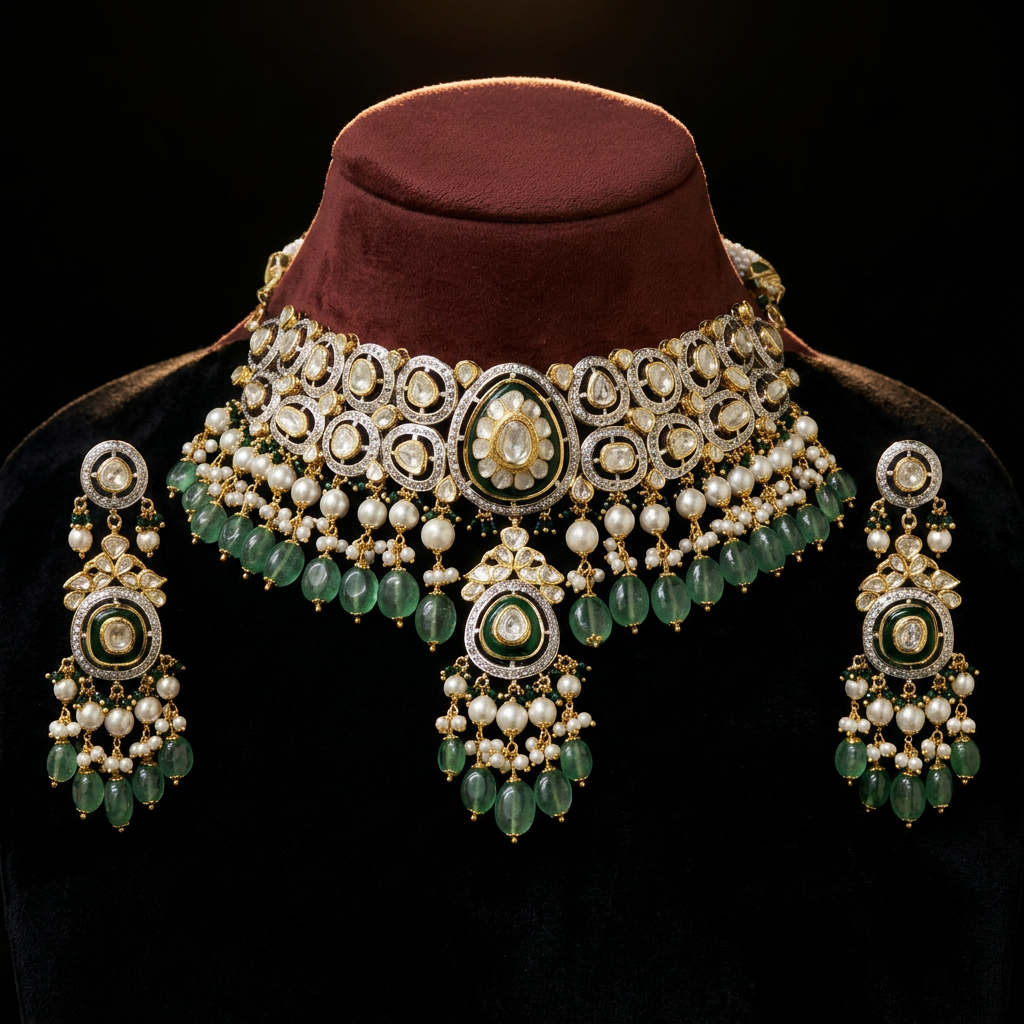
Kundan is often mistaken for a type of stone. It isn't. Kundan is a setting technique in which gemstones are secured with highly refined gold rather than conventional prongs or claws. The word itself is associated with highly refined, pure gold — the material traditionally used in the setting, and the reason the technique works at all: only very high-karat gold is soft enough to be shaped this way by hand.
Where a modern setting grips a stone with metal claws, a Kundan setting surrounds it. A thin foil of pure gold is pressed and burnished around the edges of the stone until it holds firm on its own, seated in a bed of gold rather than gripped by it. The result is a distinctive "floating" look — the stone appears to sit on the surface of the piece rather than being clamped into it.
Kundan, Polki, and Jadau: Terms That Aren't Used Consistently
This is where a lot of jewelry writing oversimplifies, so it's worth being precise. Three terms get used around this craft, and they don't map onto each other as neatly as most guides suggest:
- Jadau is the broadest term — the traditional hand-setting technique itself, where stones are pressed into a soft gold or metal base without prongs or claws. Both Kundan and Polki work fall under this umbrella.
- Kundan, in its most historically grounded sense (the one museums and craft institutions use), refers specifically to the pure gold foil used to secure a stone in this setting — the material and method, not the stone itself.
- Polki refers to a diamond left uncut or only lightly shaped, keeping something close to its natural rough form rather than being cut into a faceted brilliant.
Where it gets genuinely inconsistent: in everyday retail and workshop usage, "Kundan" is often used to mean something more specific — a piece set with polished glass, crystal, or synthetic stones, as distinct from "Polki," which specifically means genuine uncut diamonds. Under this usage, "Kundan jewelry" and "Polki jewelry" describe two different products — one with imitation stones, one with real uncut diamonds — both made using the same Jadau setting method.
Neither usage is simply wrong; they reflect the same craft language evolving differently between museums, historians, and the working jewelry trade. What matters practically: if you're told a piece is "Kundan," ask whether the stones are diamonds, other precious gems, or glass — the setting technique alone doesn't tell you that.
How a Kundan Piece Is Made
This is skilled handwork, and a single elaborate piece can take an artisan — a Kundansaz — several weeks from start to finish. The exact terminology and sequence vary between workshops, but traditional Kundan work involves several specialist stages:
- Framework. The gold skeleton of the piece is shaped and built first, defining where every stone will sit. This stage can involve soldering the underlying gold framework itself — it's specifically the stone-setting step, not the whole construction, that avoids prongs and claws.
- Base filling. The framework is often filled with lac, a natural resin, giving the setting its structure and something workable for the stones to be pressed into.
- Foiling. Extremely thin sheets of pure gold foil are laid into the setting — the step that gives the technique its name.
- Stone setting. The gemstones or uncut diamonds are pressed into the soft foil.
- Burnishing. The foil is worked and pressed around each stone's edges with a specialised tool until it locks the stone in place without any mechanical grip.
- Finishing. The piece is cleaned and polished to remove excess material.
In many traditional Kundan pieces, particularly bridal ones, the reverse side is finished with Meenakari — enamel work that turns the back of the piece into its own decorative surface. It isn't present on every Kundan piece, but where it is, it's one of the craft's most celebrated features: a piece with as much detail hidden on the inside as shown on the outside.
Where It Comes From
Kundan's history in India is closely associated with the Mughal and Rajput courts, where the technique developed into one of the country's most distinctive forms of gemstone setting. The Victoria and Albert Museum, which holds an extensive collection of Mughal-era jewelry, notes that goldsmiths of the Mughal court combined Kundan setting with enamelling by the late 16th century — a pairing that has defined the look of the craft ever since. Jaipur and other centres in Rajasthan later became especially renowned for the work, and remain the heart of the craft today.
Why It Still Matters
Machine-set jewelry can be faster and more uniform. What it can't replicate is the specific, irregular beauty of a hand-burnished gold setting, or the individual character and natural irregularity of a genuinely uncut diamond. Every Kundan piece carries small variations that come directly from being shaped by hand — which is exactly why the craft has survived, largely unchanged in method, for centuries.
Continue reading: Kundan vs. Polki: What's the Difference? →
Explore the craft in our own Kundan & Polki Heritage collection →, or learn more about how a piece comes together in The Bespoke Journey →
Common Questions About Kundan
- What is Kundan jewelry?
- Kundan is a traditional Indian setting technique, not a stone. Gemstones are held in place by highly refined pure gold foil pressed around their edges, rather than by prongs or claws. The word “kundan” refers to that purified gold itself — soft enough to be shaped and burnished entirely by hand.
- Are kundan stones real diamonds?
- Not necessarily. In everyday trade, “kundan” often describes pieces set with polished glass or crystal, while “polki” means genuine uncut diamonds — though both use the same Jadau setting method. If a piece is described as kundan, ask whether the stones are diamonds, other gems, or glass.
- Is kundan real gold?
- The setting is. Traditional kundan relies on very high-karat, highly refined gold, because only soft, near-pure gold can be pressed and burnished around a stone by hand. The stones set within it, however, may be uncut diamonds, other gemstones, or imitation stones depending on the piece.
- What is kundan work?
- Kundan work is the hand process of setting stones in pure gold foil: an artisan builds a gold framework, fills it with natural lac resin, lays in thin gold foil, presses in the stones, and burnishes the foil around each until it locks in place — often finished with meenakari enamel on the reverse.
- What is the difference between kundan and polki?
- Polki refers to the diamond — one left uncut, or only lightly shaped to keep something close to its natural form. Kundan refers to the setting technique that holds it, though in everyday trade “kundan” can also describe pieces set with glass rather than diamonds. Both are made using the same Jadau method.
- Where does kundan jewelry come from?
- Kundan is closely tied to the Mughal and Rajput courts, where court goldsmiths paired kundan setting with enamelling by the late 16th century. Jaipur and other centres in Rajasthan became renowned for the craft and remain its heart today.